
Office Snack Delivery Boston
It is February 9th in Boston. There is a grey berm of old snow between you and the door. The wind is coming off the harbor and doing that thing it does in the Seaport where it arrives from four directions at once.
Nobody is walking to get a sandwich. Whatever is in the kitchen is what your team is eating today, and tomorrow, and for the next ten weeks.
Short answer: office snack delivery in Boston runs $199 to $399 a month for a 10 to 15 person team, one box of 150 individually wrapped snacks, free shipping, no contract. The Boston adjustment is seasonal and sharper than most cities: plan on 40 percent higher consumption from December through March, and plan for the week a storm means half the team is remote and the other half is stuck in the office.
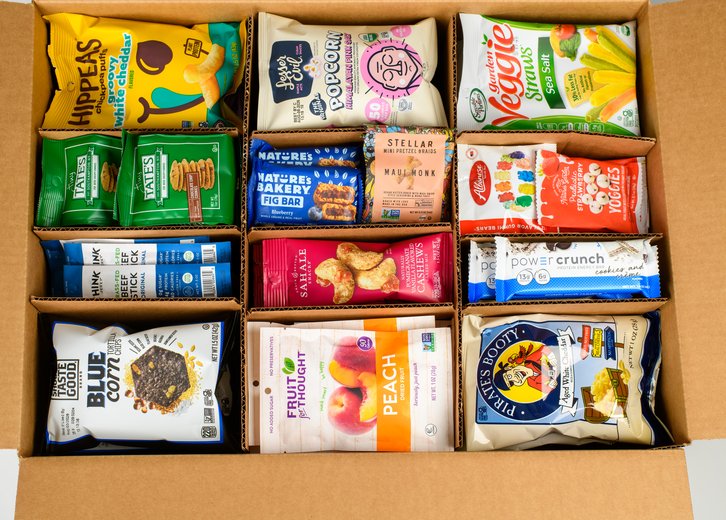
Table of Contents
- Winter is a line item
- What it costs
- Kendall, the Seaport, and the lab problem
- The academic calendar nobody budgets for
- Old buildings, small freight
- Other markets
- Quick answers
Winter is a line item
Most cities have a mild seasonal swing in office snacking. Boston has a season.
From roughly December through March, leaving the building stops being a casual decision. It involves a coat, boots, and a genuine assessment of whether the sandwich is worth it. Consumption climbs and stays climbed, and offices that sized their box in September spend February with an empty shelf.
The storm weeks are their own thing. A real snow event splits your office: some people work from home, and the ones who came in are not going anywhere until the T is running properly again. That second group eats considerably more than a normal day, at exactly the moment restocking is hardest.
Two sensible approaches. Size to winter and let the box stretch through the summer, or keep a sealed reserve in a cabinet that comes out when the forecast gets interesting. The second one costs nothing and is the one experienced office managers here already do with coffee.
What it costs
Essentials $199, Premium $299, Deluxe $399, all 150 snacks in about 15 kinds.
| Team | Summer | Dec to Mar | Monthly range |
|---|---|---|---|
| 8 to 10 | Box every 6 weeks | One box a month | $130 to $399 |
| 12 to 15 | One box | One box plus a top-up | $199 to $599 |
| 25 | Two boxes | Three boxes | $398 to $1,197 |
| 40 | Three boxes | Four to five boxes | $597 and up |
About $1.33 a snack delivered. The local comparison most people hold in their head is the coffee-and-pastry run, which is $8 or $9 by the time you have crossed the street and back, and in January costs you a coat.
Kendall, the Seaport, and the lab problem
Boston's office economy is unusually weighted toward buildings with lab space, which changes what you can put in a break room.
Any company with wet lab square footage has a hard line between where work happens and where food is allowed, and the break room is the entire permitted zone. Open bowls and shared bags create a conversation with your EHS lead that nobody enjoys. Sealed single servings make the question disappear, and every item we ship is individually wrapped for that reason. The full version of that argument is in why individually wrapped wins for medical and shared spaces.
The geography, roughly:
- Kendall and East Cambridge. Biotech and the startups orbiting it. Lab rules apply, attendance runs high because bench work cannot be done from a kitchen table.
- Seaport. Newer towers, mailrooms and loading docks, a lot of 20 to 60 person offices.
- Back Bay and Downtown. Professional services in older buildings, smaller floors, tighter kitchens.
- 128 and the suburbs. Office parks with actual storage, and the places route-based vendors will not drive to for a 15 person company.
The academic calendar nobody budgets for
Boston runs on a school year whether your company does or not.
If you take interns, co-ops or research assistants, your headcount swings by a meaningful percentage twice a year, and nobody updates the snack order. September and January arrive, the office is suddenly eight people larger, and the box that was sized correctly in July empties in two weeks.
It cuts the other way too. Late May through August a lot of Boston offices are visibly thinner, between vacations and the co-op cycle turning over.
The fix is just remembering to adjust twice a year, which is easier when you can change the order yourself before each shipment rather than calling someone.
Old buildings, small freight
Back Bay and downtown have beautiful buildings that were not designed around deliveries. Narrow freight elevators, a front desk rather than a loading dock, sometimes stairs.
None of that stops a parcel, and it is precisely what stops a route vendor with a hand truck and a restocking schedule. But two practical notes: put the delivery address where your building actually receives things, and if that is a staffed front desk, tell them it recurs monthly so the box does not sit behind the desk for a week.
Ten minutes on one named person's calendar on delivery day is the whole operational requirement. Assign it to a person, not a role.
Other markets
Free shipping to all of these and the advice shifts by city: New York City, Austin, Denver, San Francisco Bay Area and Seattle, which shares the dark-afternoon problem.
Quick answers
Do you deliver office snacks in Boston? Yes, across Boston, Cambridge, Somerville, the Seaport and out along 128. Free shipping.
How much does it cost in Boston? $199 to $399 a month for 10 to 15 people, roughly $20 to $30 per person.
Should we order more in winter? Yes. Plan on about 40 percent more from December through March, and keep a reserve for storm weeks.
Are the snacks individually wrapped? Every item, which is what makes them workable in a building with lab space.
What about interns and co-ops? Adjust the order in September and January. Headcount swings more here than in most cities.
Our building has no loading dock. Fine for a parcel. Use whatever address the building actually receives at and tell them it is monthly.
Is there a minimum office size? No. A 14 person company in Cambridge is a completely normal order.