
Office Snacks for Law Firms
It is 7:40pm the night before a filing. Three associates and a paralegal are still in. Nobody is leaving the building, because leaving the building is forty minutes of billable time nobody is going to write off.
The kitchen has decaf, a box of tea from a closed client matter, and a bag of pretzels somebody's spouse sent in.
Short answer: office snacks for a law firm run $199 to $399 a month for a 10 to 20 person office, which is one box of 150 individually wrapped snacks. The firm-specific part is that your consumption is spiky rather than steady: it tracks filings, closings and trial prep, not headcount. Size for your busy weeks, because the quiet weeks are not when anyone is eating at their desk.
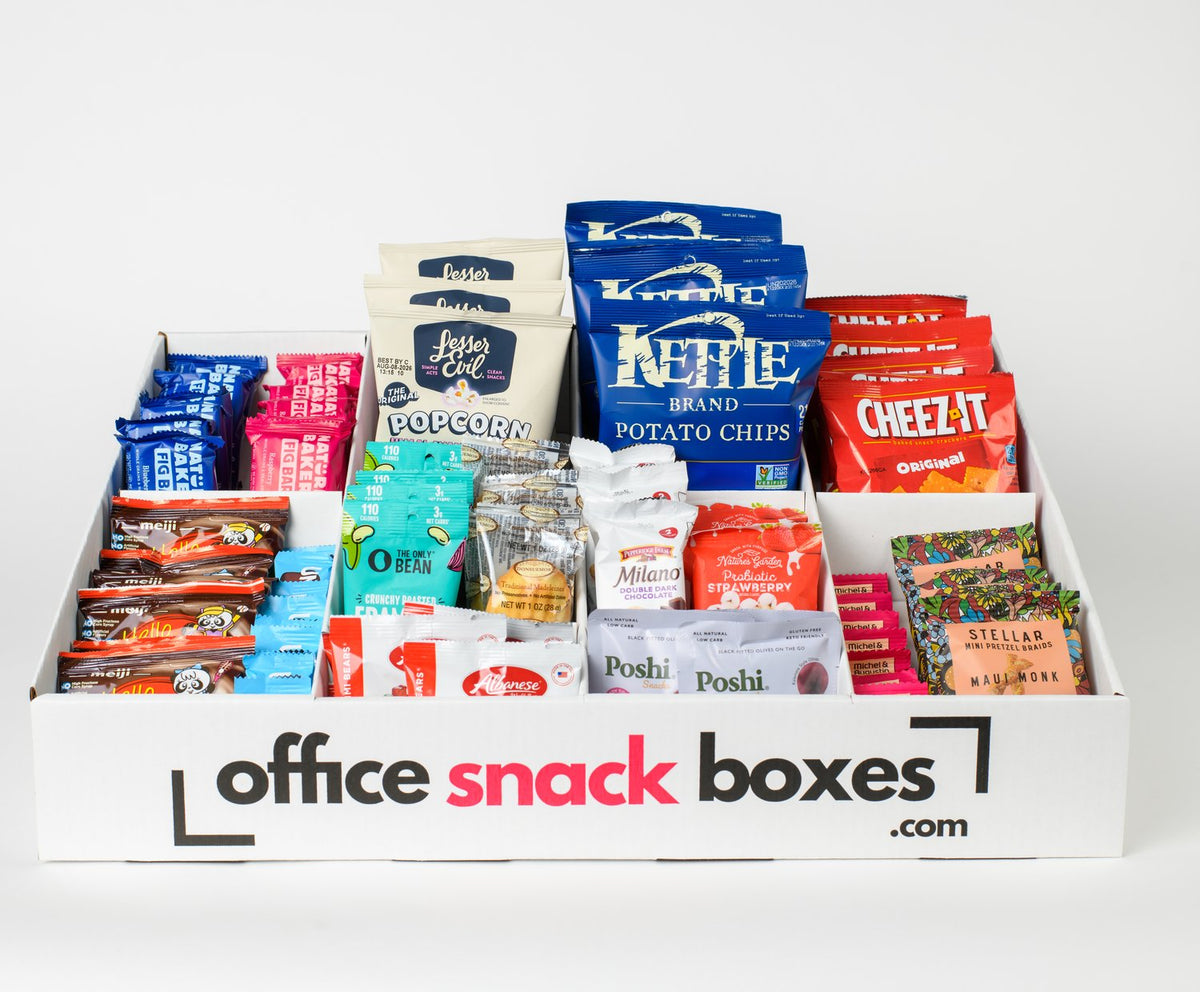
Table of Contents
- Billable hours are a snack strategy
- Why your consumption is spiky
- What it costs
- Conference rooms and client-facing space
- The people who are not attorneys
- Other guides
- Quick answers
Billable hours are a snack strategy
This is not a stretch. In most offices, leaving for food costs a person some time and some goodwill. In a firm it costs measurable revenue.
An associate billing at a few hundred an hour who walks out for lunch and comes back forty minutes later has a real number attached to that walk. Multiply by however many people do it, times however many days, and the kitchen starts to look less like an amenity and more like the cheapest productivity spend in the building.
You do not have to say any of this out loud to your team, and you should not. But it is the reason a $199 box is an easy approval in a firm where the same amount would be a conversation anywhere else.
Why your consumption is spiky
Most offices eat at a steady rate. Firms do not. The pattern looks like this:
- Normal weeks: modest. People take real lunches, leave at a reasonable hour, and the shelf barely moves.
- Filing, closing or trial-prep weeks: two to four times normal. People are in at 8pm, eating whatever is nearest, and the box empties in days.
- Deposition and closing days: a conference room full of people who are not yours, for six hours, with a break every ninety minutes.
The mistake is sizing on an average month. You will be fine for three weeks and then run out on exactly the night when running out is most demoralizing.
Two sane approaches. Size to your busy weeks and accept slack in the quiet ones, or keep a sealed reserve in a cabinet that only comes out when something is going to the wire. Firms that do the second one tend to be the ones where somebody has lived through the alternative.
What it costs
Essentials $199, Premium $299, Deluxe $399, all 150 snacks in about 15 kinds.
| Firm | People | Normal month | Heavy month | Monthly |
|---|---|---|---|---|
| Boutique / solo with staff | 5 to 10 | One box, stretched | One box | $130 to $399 |
| Small firm | 12 to 20 | One box | Two boxes | $199 to $798 |
| Mid-size | 30 to 50 | Two to three boxes | Four boxes | $600 to $1,600 |
| Multi-office | varies | One box per office kitchen | varies | |
Firms tend to land on Premium. Partly because client-facing space raises the bar, and partly because a profession that bills in six-minute increments does not generally optimize the snack budget. The general sizing math, if you want it, is in small office snack delivery.
Conference rooms and client-facing space
Different rules apply the moment a client, opposing counsel or a court reporter is in the room.
Sealed, always. An open bowl in a deposition room is a bad look and a worse surface. Individually wrapped means anyone can take something without the awkwardness of reaching into shared food in front of strangers.
Quiet food. This sounds trivial until you have sat through a transcript where someone was eating chips. Court reporters have opinions about this and they are correct. Soft, low-crunch items for anywhere a record is being made.
Nothing near documents. No powder, no grease, no anything that transfers to paper. Your malpractice carrier does not care about snacks but your partners care about exhibits.
Keep the good stuff out front. If you run one tier across the firm, the conference room is the argument for making it Premium.
The people who are not attorneys
Worth saying plainly: the paralegals, legal assistants, receptionists and office manager are the ones who will actually notice this, and they are the ones who are hardest to replace quietly.
Attorneys have expense accounts and client dinners. Support staff have a desk, a lunch hour that gets interrupted, and a salary that is not moving much this year. The break room is a larger part of their day than it is of anyone else's in the building.
It is also, bluntly, one of the few benefits you can give them that does not require a partner vote. An office manager who has been asking for something for the team and gets this is going to run the program properly, which is most of what makes it work.
One operational note: whoever opens the mail should own the ten minutes on delivery day. If it is assigned to a role rather than a person, it competes with conflicts checks and billing and it loses.
Other guides
Other professional offices with their own quirks: dental practices, medical offices, and car dealerships with customer lounges. Tiers are on the box page, process on how it works, and contracts and minimums answers the question every office manager asks second.
Quick answers
How much do office snacks cost for a law firm? $199 to $399 a month for a 12 to 20 person office. Expect to double it in filing or trial months.
How should a firm size this? On your busy weeks, not an average month. Consumption tracks deadlines rather than headcount.
What works in a deposition or conference room? Sealed, quiet and clean. Nothing crunchy where a record is being made, nothing that transfers to documents.
Are the snacks individually wrapped? Every item, which is what makes them usable in front of clients and opposing counsel.
Can we order for more than one office? Yes, and order one box per kitchen rather than one for the firm.
Is there a contract? No, cancel any time. Given the profession, that tends to be the first thing anyone checks.
Who should own it internally? One named person with ten minutes on delivery day, usually whoever opens the mail. Not a role, a person.