
Small Office Snack Delivery: Costs and Sizing
If you run a small office, you have probably done the Costco run. You took your own car, you bought 48 bags of one thing, you expensed it, and three weeks later somebody asked why there are only pretzels left. Snack delivery exists so that stops being your job.
Short answer: snack delivery for a small office runs about $199 to $399 a month for a 10 to 12 person team. That is one box of 150 individually wrapped snacks in roughly 15 different kinds, shipped to your door on a schedule you set. No contract, no minimum, no sales call. For most small offices it works out to $17 to $33 per person per month.
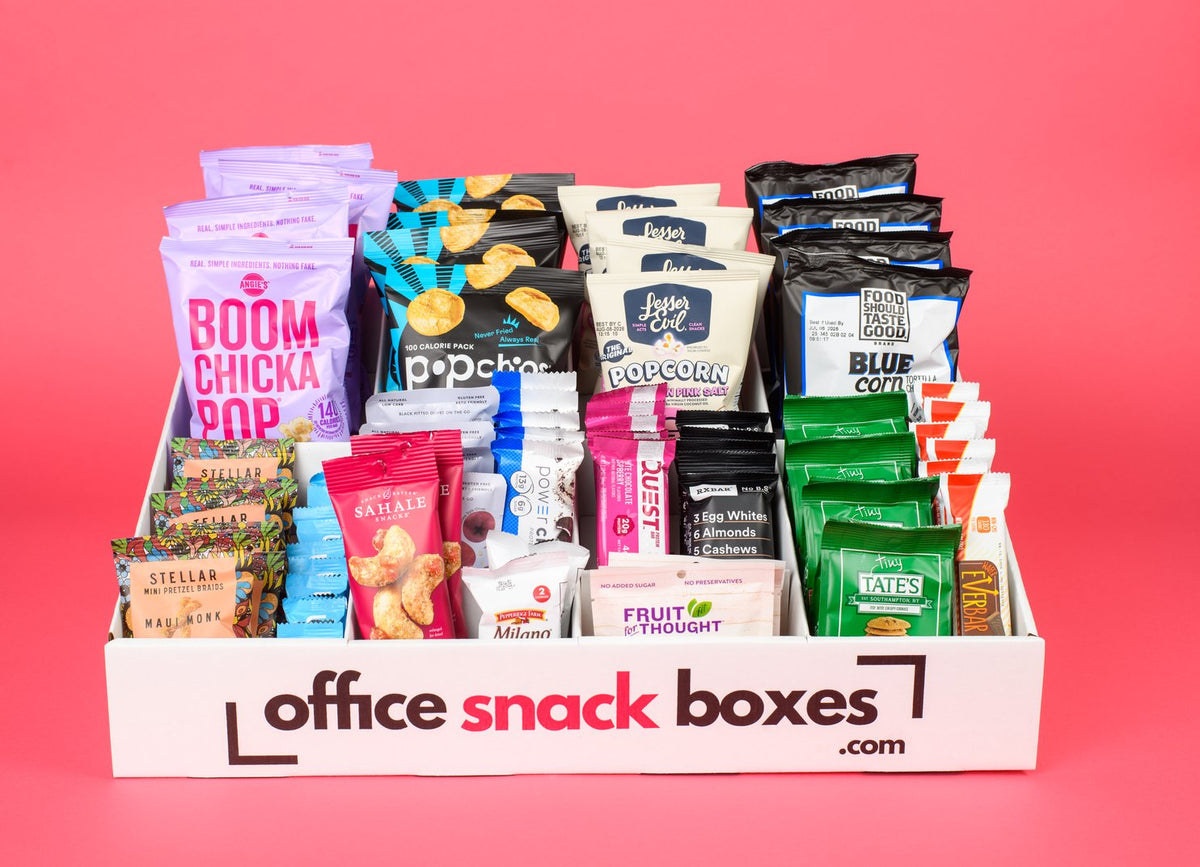
Table of Contents
- What office snack delivery actually is
- What it costs by team size
- The per-head budget table
- How the delivery part works
- Delivery vs the Costco run vs vending
- What small offices specifically get wrong
- What the first 90 days look like
- How to start without overthinking it
- Quick answers
What office snack delivery actually is
A box of snacks shows up at your office on a repeating schedule. That is the whole product. The parts that matter are the ones underneath it.
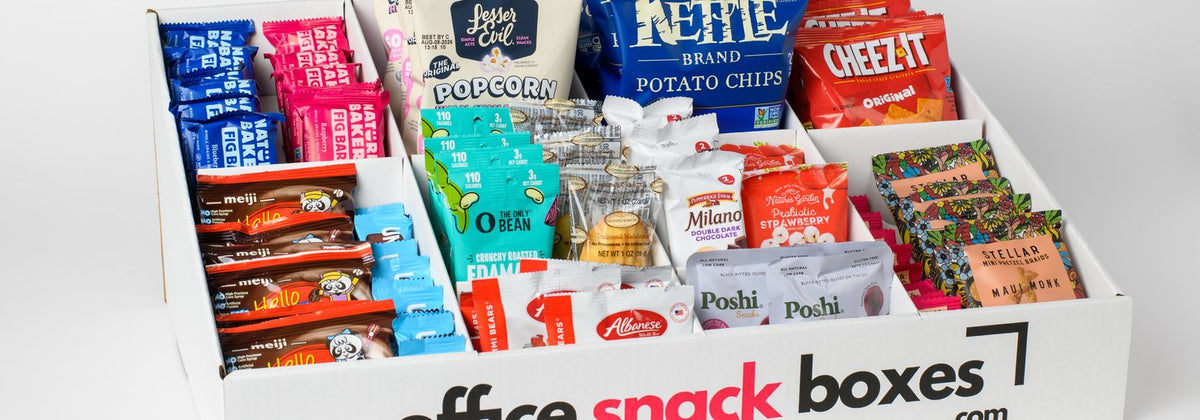
Individually wrapped, not bulk. 150 snacks in about 15 kinds, roughly 10 of each. That is the difference between a snack program and a pallet of one thing. Variety is what keeps people coming back to the shelf in week three.
You pick, or you don't. Some office managers want to choose every item. Most want to not think about it. Both should work. You should be able to swap anything out before the next box ships, based on what actually got eaten.
It repeats on its own. The point is removing a recurring task from someone's plate. If you have to place an order every month, you have bought groceries, not a snack program.
No contract. A small office should never be locked into a twelve month agreement for snacks. If it is not working in month two, you should be able to stop in month two. We went deeper on this in do office snack services require contracts or minimums.
What it costs by team size
The working formula is people times in-office days per month. Most people eat about one snack per in-office day. A hybrid team in three days a week is around 13 days a month, so a 12 person team is about 156 snacks. That is why a 150-snack box lands where it does. If you want the full derivation, we wrote it up in how many snacks does a small office actually need.
| Team size | Snacks needed per month | What to order | Monthly cost | Per person |
|---|---|---|---|---|
| 5 people | about 65 | One box every other month | about $100 | about $20 |
| 10 to 12 people | about 150 | One box a month | $199 to $399 | $17 to $33 |
| 20 to 25 people | about 300 | Two boxes a month | $398 to $798 | $16 to $32 |
| 40 to 50 people | about 600 | Four boxes a month | $796 and up | $16 to $20 |
The three tiers are Essentials at $199, Premium at $299 and Deluxe at $399, all 150 snacks. The difference is what is in them, not how many. Essentials is the everyday stuff people actually reach for. Premium adds better-known brands and more protein and better-for-you options. Deluxe is the one you order when the office is also a showroom and clients see the shelf.
At $199 for 150 snacks you are at about $1.33 a snack delivered. For comparison, a vending machine charges your team $2 to $3 for the same bag, and the Costco run costs you a bulk price plus somebody's Saturday.
The per-head budget table
If you are the one who has to defend a number in a budget conversation, this is the table you want. It is monthly spend per employee, by team size and tier.
| Team size | Essentials ($199/box) | Premium ($299/box) | Deluxe ($399/box) |
|---|---|---|---|
| 5 people (box every other month) | $19.90 | $29.90 | $39.90 |
| 10 people (1 box/mo) | $19.90 | $29.90 | $39.90 |
| 15 people (1.5 boxes/mo) | $19.90 | $29.90 | $39.90 |
| 25 people (2 boxes/mo) | $15.92 | $23.92 | $31.92 |
| 50 people (4 boxes/mo) | $15.92 | $23.92 | $31.92 |
Two things fall out of this that are worth knowing before you pick a tier.
Per-person cost is basically flat until about 20 people, then it drops. Below 20 you are sizing to a whole box regardless, so the per-head number sits wherever the tier puts it. Above 20 you start buying boxes in proportion to actual headcount and the rounding stops working against you.
The tier matters more than the team size. Moving from Essentials to Deluxe doubles your per-person cost. Adding fifteen people barely moves it. If the budget is tight, the lever is the tier, not the headcount.
For context on whether $20 or $30 a head is the right number for your company, how much should office snacks cost per employee has the benchmarks.
How the delivery part works
Four things worth knowing before you order.
- It ships nationwide. This is not a route service that only covers a few metros. If UPS can find you, you can have a snack program. That matters for small offices outside major cities, which most route-based providers will not serve at all.
- You set the cadence. Monthly is right for most teams. A 5 person office is usually better on every other month. A 30 person floor might want twice a month so the shelf never goes empty around the 20th.
- Somebody has to put it away. Small thing, real thing. A box of 150 snacks needs ten minutes and a shelf. Decide who does that before the first delivery, or it sits in the mailroom.
- You can change it before it ships. The month-one box is a guess. The month-two box should not be. What is gone by the 10th, order more of. What is still sitting there on the 25th, drop.
Delivery vs the Costco run vs vending
Three real options for a small office, and they fail in different places.
The Costco run wins on raw price per unit and loses on everything else. You get quantity without variety, you spend two to three hours a month including the drive and the put-away, and the cost lands on whoever is willing to front it. If you value that person's time at anything, the math stops being favorable fast. It also quietly becomes one person's permanent unpaid job, and they resent it by month four.
Vending costs you nothing up front, which is the appeal, and then charges your team $2.50 for a bag of chips. It is a benefit your employees pay for. For a small office you usually cannot get a machine anyway, because vending operators want the foot traffic of a few hundred people to justify the service visits.
Delivery costs more per snack than bulk and less than vending, gives you variety bulk cannot, and takes the recurring task off a human. The honest downside is that it is a real line item on the budget every month, where the Costco run hides inside somebody's expense report.
If you want the longer version of the bulk comparison, we wrote one: why subscriptions beat buying in bulk.
What small offices specifically get wrong
Four patterns we see constantly at the 5 to 25 person size.
Ordering for the headcount instead of the attendance. A 20 person company with a three-day hybrid policy is a 12 person office on any given day. Size for who is actually in the building or you will be throwing snacks away.
Buying variety once. The first box is exciting because everything is new. The fourth box is boring if it is identical. Rotating a few items every month costs nothing and is most of what keeps a program feeling alive, which is the argument in why you should rotate your box every order.
Forgetting the dietary spread. In a 12 person office you almost certainly have at least one person who is gluten-free, one who is vegan, and one who is trying to hit a protein number. Three or four items that cover them is the difference between a shelf everyone uses and a shelf most people use. Feeding a team with mixed dietary needs covers how to build that spread without turning it into a project.
Treating it as a perk instead of infrastructure. The teams that get the most out of it are the ones who stop thinking about it. It is closer to the coffee order than to a holiday party. It should be boring and it should just happen.
What the first 90 days look like
Most of the value shows up in how you adjust, not in what you order first. Here is the rhythm that works.
Month one is a guess and that is fine. Order one box at the tier that matches your team, put it somewhere people walk past rather than somewhere tidy, and watch. The single most useful data point is which shelf is empty on the 10th. You are not trying to get this right, you are trying to learn something.
Month two is the adjustment. Before box two ships, spend five minutes swapping. Double whatever vanished in the first week. Remove whatever is still sitting there. If the box ran out before the 25th, size up or add a second delivery. If you have snacks left over on the 30th, stretch to every other month instead of dropping a tier, because dropping a tier costs you variety and stretching does not.
Month three is where it either becomes infrastructure or dies. The failure mode is nobody owning it. If the box arrives and sits in the mailroom for four days, the program is already over even though you are still paying for it. Put ten minutes on one person's calendar for delivery day. That is the entire operational requirement.
By day 90 you should know your real consumption number, your team's three favorite items, and whether your tier is right. That is a better office snack program than most companies ten times your size are running.
How to start without overthinking it
Count who is actually in the office on a normal day, multiply by the days they are in, and round to the nearest box. If that number is under 100 snacks, start with one box and stretch it. If it is 150 to 200, start with one box a month. Pick the tier that matches what your team is like, not what you wish they were like.
Then change it after box one. That is the part people skip. The first box tells you more about your office than any survey will, and it takes about five minutes to act on.
You can see the three tiers and what is in each on the box page, or read the full process on how it works.
Running something other than a standard office? We have specific guides for medical office snack delivery and for coworking space snack delivery, both of which size differently than a normal office does. And if you are at the very small end, the 5 person office snack guide is the narrower version of this page.
Quick answers
How much is snack delivery for a small office? About $199 to $399 a month for 10 to 12 people, which is one box of 150 snacks. Around $20 to $30 per person per month.
Is there a minimum order? No. One box is a fine order, and plenty of 5 to 8 person offices order one box every other month.
Do I have to sign a contract? No. Cancel any time, and you should be suspicious of any snack provider who asks a small office for a term commitment.
How fast does it ship? Boxes go out within a few business days and ship nationwide. Most offices see the first one inside a week.
Can I choose the snacks? Yes, or you can let us pick. Both are normal, and you can switch between the two at any point.
What if 150 snacks is too many? Stretch the box across two months. For a 5 person office that is usually the right rhythm and it keeps the per-person cost near $20.
Do you deliver outside major cities? Yes. This ships nationwide rather than running on a local route, which is exactly why it works for small offices that route-based providers turn down.
What is the cheapest way to do office snacks? Buying in bulk is cheapest per unit and most expensive in time and variety. For a small office, one Essentials box a month at about $20 per person is usually the best balance of the three.
Who should own the snack program internally? One named person with ten minutes on delivery day. It does not need to be a manager and it should not be a committee.